

À propos de l'exposition
La montée des périls affecte, sur tous les continents, la sécurité des individus et des organisations mobilisés pour les droits humains. S’appuyant sur les recommandations des Nations Unies, des Organisations Non Gouvernementales de Développement (ONGD) luxembourgeoises mettent en lumière des femmes et des hommes qui se lèvent pour défendre les droits humains. Leur lutte, qui vise la réalisation d’un monde plus juste, nous concerne tous.
PRÉFACE
MARY LAWLOR, SPECIAL RAPPORTEUR ON THE SITUATION OF HUMAN RIGHTS DEFENDERS
Who are human rights defenders? Human rights defenders are people who promote and protect the human rights of others, often at great personal risk. They are ordinary people who do extraordinary things. Any person, regardless of age, gender or background, who is acting peacefully in defence of human rights and in accordance with international law, can be a human rights defender.
The human rights defenders presented in this exhibition are some amongst thousands, all over the world, who carry out a peaceful struggle for the rights of others. The way they do so varies greatly, and largely depends on the context in which they find themselves. Many individuals, such as those living in conflict areas, are compelled to be human rights defenders out of necessity. Others choose to champion human rights causes despite great adversity and pushback in the societies they live in. Some are part of large movements, others defend rights as part of communities, and there are those who act on their own. All of them, whoever they are and however they carry out their peaceful work, are drivers of change who help build more just and equal societies around the world.
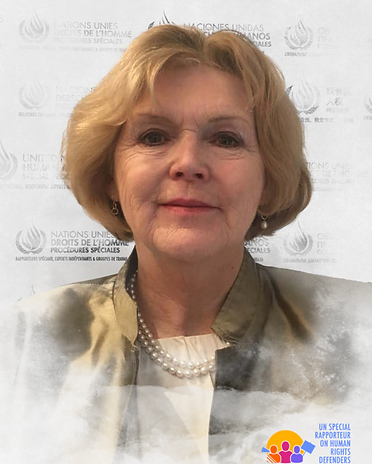
Mary Lawlor
Special rapporteur on the situation of human rights defenders
However, the very nature of their work often places human rights defenders in significant danger. They face a range of threats, including harassment, intimidations, physical and digital attacks, unfair trials on spurious charges, imprisonment, and in the most extreme cases, enforced disappearances, torture and killings. Front Line Defenders documented the killings of at least 300 human rights defenders around the world in 2023, a third of whom were indigenous people’s rights defenders. Long term imprisonment is also a tactic and trend used by oppressive governments to neutralise their work and get them out of the way. At least 100 human rights defenders in 16 countries are currently serving at least 10 years and in some cases life imprisonment due to their peaceful and legitimate work. Long term imprisonment is for me one of the cruellest violations, as the defenders fade from the mind as they fade from the sight – helpless, hopeless and forgotten. In many countries, repressive governments are enacting laws specifically designed to stifle human rights defenders’ efforts, or abuse the existing legal system, including anti-terror legislation, to prosecute them. Women human rights defenders and LGBTQI+ rights defenders, who often challenge traditional patriarchal and heteronormative systems, face additional threats and challenges because of who they are. Human rights defenders working to protect the environment, defend land rights or indigenous rights, are amongst those most at risk of being killed. Defenders of the rights of refugees, migrants and asylum-seekers are increasingly vilified and criminalised for trying to save lives and assist those in danger. Being a human rights defender takes courage, resilience and a largeness of spirit in the face of such adversity. I am in constant awe of their fiery hearts, filled with passion, compassion and care. And let me tell you, the next generation of human rights defenders, children and young people with whom I have spoken over the years, are beyond worthy successors of the global human rights movement. Human Rights Defenders, young and old, all over the world, in democracies and dictatorships, in cities, in forests and in deserts, are achieving huge successes often in the face of terrible danger. Supporting human rights defenders is not an act of charity. It is a moral imperative and a strategic necessity. Human rights defenders must have the freedom to highlight and expose human rights violations, regardless of who commits them. They must have the freedom to peacefully assemble, and to be involved in the civic life of their country. They must have the freedom to seek resources, including from abroad. In short, they must have the right to defend rights. To ensure a safe and supportive environment for human rights defenders, recognition, visibility and legitimacy are key. Human rights defenders are not the enemies so States should respect their work and put in place protection mechanisms that are implemented, in consultation with them. In the words of disability rights defenders: “Nothing about us without us”. The failure of governments and corporate leaders to listen to human rights defenders’ voices has contributed to many of the problems we are facing today. At a time when the forces of authoritarianism and repression are on the rise, the work of human rights defenders is more vital than ever. It is our collective responsibility to ensure that they have the support and protection they need to continue their essential work. We stand in solidarity with them and recognise that their fight is not just a local or national issue, but a global one, that affects the very fabric of our shared humanity. In 2023, to commemorate the 25th anniversary of the UN Declaration on Human Rights Defenders, I commissioned a poem from British-Kashmiri writer Nikita Gill. The following verses are drawn from the work she created, ‘Seeds of Hope’, which perfectly captures the spirit of human rights defenders:
“They say at the end of every tunnel, there is a light.
What they do not tell you is that someone has to be there
to hold up that light so that others can see the path, wielding the torch of truth, no matter how hard it is to bear.”

Des organisations non gouvernementales de développement (ONGD) luxembourgeoises s’inquiètent de la montée des périls qui menacent, partout dans le monde, les individus et les organisations mobilisés dans la défense des droits humains. S’appuyant sur les recommandations des Nations Unies, ces ONGD se sont engagées à mettre en lumière le combat de femmes et d’hommes qui se lèvent chaque matin et qui se battent pour un monde plus juste. Leur lutte est universelle et nous concerne tous.
Les Nations Unies définissent les défenseurs et défenseuses des droits de l’homme comme “des personnes qui, individuellement ou en association avec d’autres, œuvrent à la promotion ou à la protection des droits de l’homme de manière pacifique.”
Elles et ils se définissent par leur engagement, exprimé à travers leurs actions en tant que citoyen·ne·s, leaders de communauté, journalistes, avocat·e·s, syndicalistes, étudiant·e·s, membres d’organisations de défense des droits humains,... Elles et ils défendent une variété de droits allant des droits des femmes à ceux de l’environnement, en passant par les droits des peuples indigènes et bien d’autres.
Dans de nombreux pays, leur mobilisation les expose à des risques personnels considérables, souvent face à, des gouvernements, des entreprises privées, des décideurs politiques ou des forces de l’ordre qui bafouent ces droits.
" Il est important que les pays qui comprennent le rôle crucial joué par les défenseurs et les défenseuses des droits humains pour la démocratie et l’état de droit adoptent une position ferme au niveau international et œuvrent dans le but de renforcer leur protection. "
Mary Lawlor,
Rapporteuse spéciale de l’organisation des Nations Unies
sur la situation des défenseurs des droits humains

SITUATION DES DÉFENSEURS
ET DÉFENSEUSES DANS LE MONDE
Les 5 secteurs de droits où les défenseurs et les défenseuses sont les plus menacé·e·s :



REMARQUES
-
les données relatives aux défenseurs et défenseuses des droits humains ne sont pas toujours accessibles ;
-
lorsqu’elles sont disponibles, elles ne sont pas toujours diffusées par crainte des menaces et
des répercussions.
Les principales répressions signalées par les défenseuses et défenseurs des droits humains en 2022 comprenaient :


